—
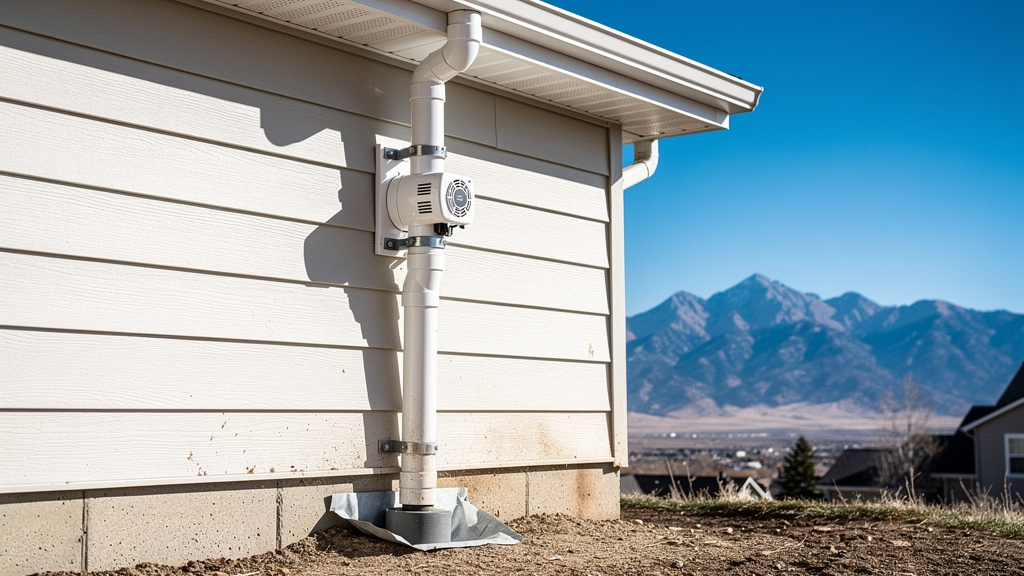
Sub-slab depressurization is the most effective and widely used method for reducing radon in Denver homes. It works by drawing radon gas from beneath your foundation slab and venting it safely outside before it can enter your living space.
—
Why Does Denver Have Such a Serious Radon Problem?
Denver sits in EPA Zone 1 — the highest-risk category for indoor radon. The region’s geology drives this. Colorado’s granite and gneissic bedrock contain naturally occurring uranium, and as that uranium breaks down over time, it produces radon gas that migrates upward through soil and into homes.
The statewide indoor radon average runs around 6.3 pCi/L — well above the EPA action level of 4.0 pCi/L. We typically see roughly half the homes tested in the Denver metro come back elevated. Neighborhoods built over disturbed or fill soils — common throughout the Front Range — can run even higher.
Summer can mask the problem. Open windows temporarily lower readings, which leads some homeowners to assume they’re in the clear. A test taken with windows open in July often reads lower than the same home tested in January, when it’s sealed tight. If you’re testing now, follow proper closed-house conditions for at least 12 hours before and during the test.
—
How Does Sub-Slab Depressurization Actually Work?
Sub-slab depressurization creates a zone of lower air pressure beneath your foundation slab, which pulls radon away from the home instead of letting it seep in.
Here’s the core idea: radon moves from high pressure to low pressure. Normally, the air pressure inside your home is slightly lower than the soil beneath it — a natural phenomenon called the stack effect. That pressure difference draws radon upward through cracks, joints, and any penetrations in your slab.
A sub-slab depressurization system flips that equation. A licensed contractor cores a hole through the foundation slab, inserts a suction pipe into the aggregate or soil layer beneath, and routes that pipe up through or around the home to a fan unit. The fan runs continuously, pulling air — and radon — from beneath the slab and exhausting it above the roofline where it disperses safely.
In most Denver homes, a single suction point handles the job. Larger footprints or homes with segmented foundations sometimes need two or more suction points to create even coverage beneath the slab. The installation typically takes four to six hours for a standard single-family home.
—
What Makes a Sub-Slab System Work Well — or Poorly?
The key variable is sub-slab communication — how freely air moves through the material beneath your slab.
Before drilling the suction point, a qualified contractor runs a diagnostic test. They drill a small hole, insert a tube, and measure how much suction can be achieved and how far it extends laterally. Homes with crushed gravel sub-bases — common in Denver construction — tend to have excellent communication, meaning one suction point can often depressurize the entire under-slab area.
Homes built on clay-heavy or tightly packed soil present more of a challenge. In those cases, we typically see contractors add suction points or reposition the pipe to find a more porous layer. Skipping this diagnostic step is one of the more common mistakes in DIY installations — the pipe ends up in the wrong spot and the system underperforms.
The fan matters too. Most residential installations use a fan rated between 20 and 50 CFM (cubic feet per minute), sized to match the sub-slab conditions. A fan that’s too weak won’t maintain sufficient negative pressure; one that’s too strong can depressurize the living space itself, which creates a different set of problems.
—
What Does a Sub-Slab System Installation Cost in Denver?
Most Denver homeowners pay between $950 and $1,700 for a standard sub-slab depressurization installation, with the average landing around $1,200 to $1,300.
More complex jobs — homes with multiple foundation sections, finished basements, or difficult pipe routing — can push toward $2,000 to $2,500. The cost breakdown generally looks like this:
| Component | Typical Cost Range |
|---|---|
| Standard single-point installation | $950 – $1,500 |
| Two-point installation (larger homes) | $1,400 – $2,000 |
| Electrical hookup for fan | $200 – $400 |
| Post-installation radon test | $150 – $250 (professional) |
| Annual system inspection | $0 – $150 |
| DIY short-term test kit (pre-installation) | $15 – $40 |
Low-income Denver homeowners may qualify for Colorado’s Low Income Radon Mitigation Assistance Program, which provides up to $1,500 toward installation costs for owner-occupied homes that meet income guidelines. It’s worth checking eligibility before paying out of pocket.
—
How Long Does a Sub-Slab System Last, and What Maintenance Does It Need?
A properly installed sub-slab depressurization system typically lasts 15 to 20 years. The fan is the only mechanical component, and most fans carry warranties of five years, with actual service life often running longer.
Maintenance is minimal but not zero. Most systems include a U-tube manometer — a small liquid-filled gauge mounted on the pipe — that shows whether the fan is maintaining suction. Check it monthly. If the fluid levels in both sides are equal, the fan has stopped working and needs to be replaced.
Beyond that, an annual check of the pipe connections, exterior exhaust point, and fan housing is enough to keep most systems running well. Some Colorado contractors include one post-installation inspection in their service agreement; others charge $50 to $150 for an annual checkup.
Retest your home for radon 24 to 48 hours after installation, and again annually. EPA recommends retesting every two years in homes without mitigation systems and annually in homes with active systems.
—
When Should You Call a Professional Instead of DIYing This?
If your test results come back at or above 4.0 pCi/L, this is not a project to attempt on your own.
Colorado requires radon mitigation contractors to hold state licensing through DORA (Department of Regulatory Agencies) and carry professional liability insurance. That licensing requirement exists because improper installation — wrong suction point location, undersized fan, poor pipe sealing — can actually increase radon entry by disrupting soil pressure in unintended ways.
Other signals that a professional is the right call:
- Your home has a crawl space combined with a slab foundation
- You have a finished basement with limited access to the slab
- Initial test results are above 8.0 pCi/L (higher levels need more aggressive system design)
- You’re in a real estate transaction — Colorado requires radon disclosure as of August 2023, and buyers will want documentation of licensed work
- You’ve had a previous system installed and levels are still elevated
A same-day consultation is often available in the Denver metro during non-peak months. Spring and fall tend to book out faster as homeowners prepare for real estate season or get ahead of winter.
—
What Should Denver Homeowners Do Next?
If you haven’t tested yet, start there. Use an EPA-approved charcoal canister kit from a hardware store ($15–$40) or hire a certified professional for a short-term test ($150–$250). Place the test in the lowest regularly occupied level of the home — basement, ground floor, or wherever you spend the most time. Keep windows closed for at least 12 hours before and during the test.
If results come back at 2.0 pCi/L or higher, follow up with a long-term test or a continuous radon monitor before scheduling mitigation. If results are at or above 4.0 pCi/L, move directly to scheduling a professional assessment. Don’t wait on it — radon exposure is cumulative, and the fix is straightforward when the system is designed correctly from the start.
RadonSweep connects Denver homeowners with licensed radon mitigation professionals who understand Front Range geology, local building codes, and the specific foundation types common across the Denver metro. If your test results have you concerned, getting a professional assessment is a practical next step — not a dramatic one.
—
FAQ
Q: How long does sub-slab depressurization installation take?
Most standard single-family home installations take four to six hours. Larger homes or complex foundation layouts may require a full day.
Q: Will the fan run constantly and add to my electricity bill?
Yes, the fan runs 24/7, but most residential radon fans use 20–90 watts — roughly $3–$10 per month added to your electric bill.
Q: Can sub-slab depressurization make my home feel drafty or cold?
A properly sized system shouldn’t. Over-powered fans can slightly depressurize the living space. A licensed contractor sizes the fan to match your specific sub-slab conditions.
Q: Do I need a permit in Denver to install a radon mitigation system?
Denver typically requires a building permit for radon mitigation system installation. Your licensed contractor should pull this permit before starting work.
Q: Will summer test results accurately reflect my radon levels year-round?
Not always. Open windows lower readings temporarily. Test under closed-house conditions, and consider a long-term test for the most accurate annual average.
—
Sources
- U.S. Environmental Protection Agency: Home Buyer’s and Seller’s Guide to Radon and radon action level guidelines
- Colorado Department of Public Health and Environment: Radon Program FAQ and Mitigation Guidelines
- Colorado Department of Regulatory Agencies (DORA): Radon Mitigation Contractor Licensing Requirements
- Colorado Environmental Public Health Tracking: Indoor Radon Statistics and Disclosure Requirements
- Colorado Geological Survey: Radon Occurrence and Colorado Geology
- U.S. Environmental Protection Agency: Consumer’s Guide to Radon Reduction — How to Fix Your Home
- Colorado Low Income Radon Mitigation Assistance Program: Program Eligibility and Benefit Information